
HACCP Plan Review and Assessment for Zya: Supporting Food Safety for a Novel Enzyme Ingredient
Wednesday, 23 September 2026
Dr Faour-Klingbeil was engaged by Zya Enzymes Ltd, a UK-based food-tech company developing a novel enzyme ingredient, , to review and assess the company’s HACCP plan. The engagement involved a systematic evaluation of the HACCP plan against Codex Alimentarius General Principles of Food Hygiene (CXC 1-1969), covering the hazard analysis, the determination of critical control points, critical limits, monitoring, corrective actions, verification and documentation. Particular attention was given to the hazards specific to enzyme production and the handling of a novel ingredient. As Zya is preparing to access the U.S. market, the assessment also considered the plan’s readiness to meet the requirements of a Food Safety Plan under the FDA’s 21 CFR Part 117, the FSMA Preventive Controls for Human Food rule. This included the identification of process, allergen, sanitation and supply-chain preventive controls, the recall plan, and the associated monitoring, corrective action, verification and recordkeeping requirements. Particular attention was given to the hazards specific to enzyme production and the handling of a novel ingredient. DFK delivered a detailed assessment report setting out areas for improvement, each supported by technical and regulatory justification and practical recommendations, giving Zya’s team a clear basis for strengthening its HACCP and Food Safety Plan. This project reflects DFK’s continued work with innovative and novel food companies, helping them build robust, science-based food safety systems as they move toward commercialisation. Interested in a HACCP plan review or food safety plan support for your novel ingredient? Contact us for a free consultation.
When Supplier Controls Matter More Than Your Own CCPs
Monday, 16 February 2026
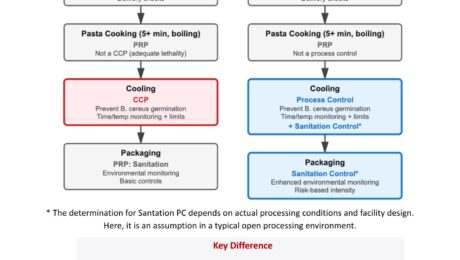
A single ingredient , pre-cooked pasta, caused 7 deaths, 28 illnesses, 27 hospitalizations and brought 6+ brands into recall. This multistate Listeria monocytogenes outbreak was linked to prepared, ready-to-eat pasta meals. We are not here to speculate about failure or assign blame. But we should reflect. Irrespective of this specific case, where the exact root cause and system robustness are not fully clear, such incidents remind us of something critical: It is time for food safety to move beyond a purely HACCP-centered mindset. HACCP asks: That logic is vital, indispensable. But it is not sufficient. When conducting risk assessments and determining management strategies, food businesses must go beyond labeling controls as CCPs or PRPs. We need a broader, risk-based Food Safety Plan mindset. In cases like this, pre-cooked, hydrated components used in RTE foods inherently require elevated scrutiny not because something necessarily failed, but because the risk profile demands it. A broader system means: • Strong supply-chain preventive controls for high-risk ingredients.HACCP often treats supplier controls as PRPs. A Food Safety Plan treats high-risk incoming ingredients as Supply Chain Preventive Controls, applying CCP-equivalent rigor. • Sanitation Preventive Controls when the hazard is environmentalWhen environmental contamination is a reasonably foreseeable hazard, sanitation is no longer “just a PRP”, it becomes a managed preventive control. • Allergen Preventive Controls where cross-contact risk is significant.When severity is high, allergen management requires structured and robust preventive controls. • Verification beyond documentation.Does your supplier have validated preventive controls?Are you reviewing real performance data and environmental monitoring trends — not just Certificates of Analysis? • Environmental monitoring expectations at supplier level, where relevant. • Risk-based intensity of oversight proportional to severity. • and more…. Food Safety Plans change how we think. They shift us from diagram compliance to hazard-control strategy design. And that shift is not theoretical. It is necessary. If you manufacture or brand RTE foods, your strongest critical control may ALSO sit at your supplier’s site. I have prepared a very simplified illustration showing how HACCP and a Food Safety Plan approach may differ, both at the level of the pre-cooked pasta manufacturer and at the level of the brand owner using it in finished RTE products. Have a look at it here: If you have questions about what FDA registration means for your facility, which regulations apply to your operation, or how to design compliant food labels and build a compliant HACCP and Food Safety Plan for the US and EU market, DFK Safe Food Environment provides regulatory consulting, FSPCA training, and FSMA compliance support for domestic and international food businesses.
- Published in FDA Compliance, Food safety and trade, FSMA