All our courses are available virtually or at a location and time convenient to you.
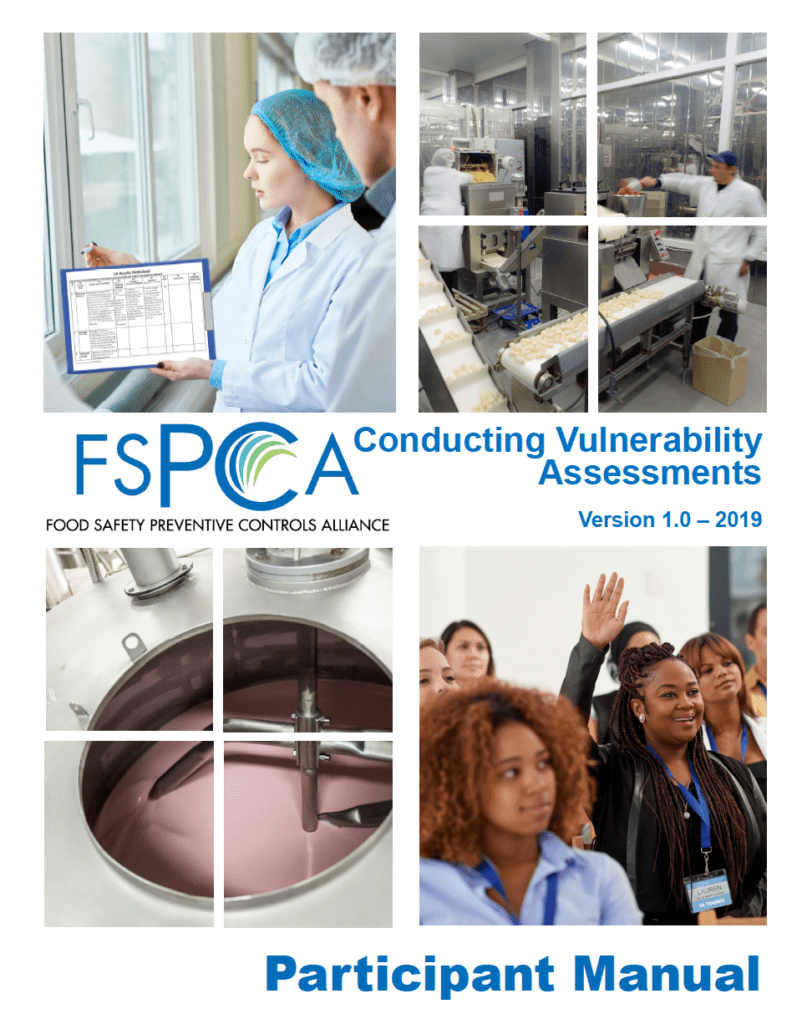
Welcome to the FSPCA IA Conducting Vulnerability Assessments Participant Course— This course is designed to assist food businesses to comply with the FDA’s Intentional Adulteration (IA) rule (21 CFR Part 121) requirements, part of the Food Safety Modernization Act (FSMA), designed to safeguard the food supply against deliberate tampering.
The Mitigation Strategies to Protect Food Against Intentional Adulteration regulation (referred to as the IA rule) aimed at preventing intentional adulteration from acts intended to cause wide-scale public health harm, including acts of terrorism targeting the food supply. The regulation requires that certain activities must be completed by a “food defense qualified individual” who has successfully completed training in the conduct of a vulnerability assessment (21 cfr 121.4).
This course developed by the FSPCA is the “standardized curriculum” recognized by FDA; successfully completing this course is one way to meet the requirements for a “food defense qualified individual” responsible for conducting a vulnerability assessment.
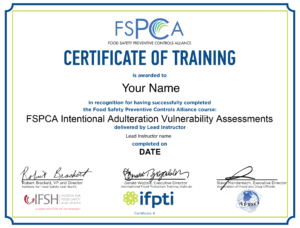
Upon successful completion of the course, participants will receive an official certificate from the Food Safety Preventative Controls Alliance signed by AFDO (US Association of Food & Drug Officials) by IFSH (Institute for Food Safety & Health) and IFPTI (International Food Protection Institute)
Delivered live, in-person, and/or virtually by Dr Dima Faour-Klingbeil, FSPCA IAVA and PCQI Lead Instructor
Domestic and foreign companies (food exporters) that are required to register with the FDA as food facilities must comply with the IA Rule, unless exempted. See if you are exempted.
The FDA’s IA rule which is the short name for “Mitigation Strategies to Protect Food Against Intentional Adulteration regulation (21 CFR Part 121)” is aimed at preventing intentional adulteration from acts intended to cause wide-scale harm to public health, including acts of terrorism targeting the food supply. Such acts, while not likely to occur, could cause illness, death, economic disruption of the food supply absent mitigation strategies.
Rather than targeting specific foods or hazards, this rule requires mitigation (risk-reducing) strategies for processes in certain registered food facilities and that certain activities must be completed by a “food defense qualified individual.”
Get in touch to chat about this ! I can assist you to ensure compliance with the FSMA rules in several ways: free consultation for straightforward inquiries, gap analysis, Food Safety Plan revision and evaluation, private PCQI training and others.
Conducting a vulnerability assessment is a critical component of developing a food defense plan, which is a requirement under the FSMA rule “ Mitigation Strategies to Protect Food Against Intentional Adulteration” (21 CFR Part 121).
Successfully completing this course is one way to meet the requirements for a “food defense qualified individual” responsible for conducting a vulnerability assessment.
The FSPCA IA Conducting Vulnerability Assessments Participant Course will equip participants with the tools to assess and address vulnerabilities in food production processes that could be exploited for intentional adulteration, such as acts of terrorism or sabotage. These acts could result in adverse health consequences and death, and economic disruption of the food supply.
Participants will gain expertise in applying the FDA's three key elements of vulnerability assessment, learning about the different methods employed in determining the overall vulnerability of a food operation and identifying actionable process steps.
This comprehensive curriculum not only equip the participants with the tools to meet the regulatory requirements outlined in the FSMA Mitigation Strategies to Protect Food Against Intentional Adulteration (IA) regulation (21 CFR Part 121) but also positions them as a "food defense qualified individual."
Upon successful completion of the course, participants will receive an official FSPCA certificate.
This course is ideal for members of domestic and foreign companies (food exporters) that are required to register with the FDA as food facilities and must comply with the IA Rule:
Two potential methods can be used to conduct vulnerability assessement, the Key Activity Type (KAT) and/or the Three Fundamental Elements methods. If you conduct your vulnerability assessment using the KAT method with no modifications, you should consider completing the FSPCA IA Conducting Vulnerability Assessments Using Key Activity Types course and may not need the training provided in this course.
However, if you use any modifications to the KAT method or plan to use the Three Fundamental Elements method, then this course would provide valuable insights.
By completing this course, you will:
This is a participant-driven course that combines expert instruction with practical exercises. The course is offered in a variety of formats to suit your needs:
Upon successful completion of the course, participants will receive an official certificate from the Food Safety Preventative Controls Alliance signed by AFDO (US Association of Food & Drug Officials) by IFSH (Institute for Food Safety & Health) and IFPTI (International Food Protection Institute).
The FSPCA Intentional Adulteration Conducting Vulnerability Assessments using Key Activity Types course before attending the in-person FSPCA Intentional Adulteration (IA) Vulnerability Assessments course. This is an online course provided by the FSPCA.
And the two free online courses:
This PCQI course covers all aspects of preventive controls, hazard analysis, and risk-based strategies required under FSMA Preventive Controls rule.This course is the standardized curriculum recognized as adequate by the FDA.
Our Location
Contact
Affiliates & Partners
Website Designed and Developed by entasiz