
DFK at IAFP 2025: Addressing Chemical Hazards in Water Reuse
Wednesday, 30 July 2025
DFK was pleased to be invited to present at the 2025 International Association for Food Protection (IAFP) Annual Meeting in Cleveland, Ohio, 27-30 July . The symposium, “Managing Chemical Hazards in Water Reused in Food Production and Processing,” brought together experts to discuss one of today’s most pressing food safety challenges, the risk of emerging chemical contaminants risk in water reuse. These substances have been detected even in regions considered pristine, highlighting the global nature of chemical contamination. As water reuse becomes an increasingly important sustainability strategy in food production, managing chemical risks and ensuring regulatory alignment are more critical than ever. As part of the symposium, Dr Dima Faour-Klingbeil contributed a talk on “Regulations Around the Reuse of Water and Chemical Hazards in Food Industry Settings,” exploring how evolving regulations and risk management strategies can help safeguard food safety while supporting sustainable water practices. The session provided an excellent opportunity to exchange insights with international colleagues, bridging European and U.S. perspectives on emerging regulatory trends and scientific developments in food safety.
Safety and quality of water use and reuse in the production and processing of dairy products
Wednesday, 07 June 2023
In 2020, the 43rd session of the Codex Alimentarius Commission approved the new work entitled “Development of Guidelines for the Safe Use and Reuse of Water in Food Production” proposed by the 51st session of the Codex Committee on Food Hygiene. To support this work, the Joint FAO/WHO Expert Meeting on Microbiological Risk Assessment (JEMRA) was asked to provide scientific advice regarding safe use and reuse of water in the dairy sector. Dr. Dima participated in the JEMRA experts panel tasked to provide clear and practical guidance on risk-based approaches to assess and manage fit-for-purpose water sourcing, use and reuse in the dairy sector. The collective efforts led to publication of a report that describes the application of the concept of fit-for-purpose water for use in the production and processing of dairy products. Report available in this link: FAO & WHO. 2023. Safety and quality of water use and reuse in the production and processing of dairyproducts – Meeting report. Microbiological Risk Assessment Series, No. 40. Rome, FAO.https://doi.org/10.4060/cc4081en

IAFP 2022 European Symposium – Munich
Monday, 27 June 2022
Dr Faour-Kingbeil was invited to the International Association of Food Protection Annual Meeting, Munich, German, May 4-6, 2022. She joined other experts in the symposium session titled “Safety and Quality of Water Used and Reused in Fresh Produce Supply Chains” to offer a presentation on “Bringing Fit-for-Purpose Applications into Fresh Produce Operations and Managing Control”. Water scarcity is a global issue resulting from diminishing water availability with the increasing water demand, water overuse, pollution, and changes in water availability due to climate change. Industries from all sectors have critical roles in alleviating water scarcity. Particularly the food and agriculture sectors are under the pressure of being the largest consumers of water. Further challenges are read with the rising demands for healthy fresh food and the rapid growth of the ready-to-eat and fresh-cut vegetables markets in the developed economies; Hence, while increasing food production, it is imperative to adopt strategies for efficient water use in the fresh produce industry to conserve water resources and reduce costs and environmental impact of the high volume of generated wastewater. Water reuse is one of the measures deemed appropriate to mitigate high water consumption. It is advocated as a valuable resource by the United Nations World Water Development Report and the circular economy perspective.Ultimately, water quality should fit the purpose it is used for, and recycling or reuse applications will have to consider water suitability which depends on its source. Thus, cross-contamination and recontamination risks are likely to occur without validated and verified control steps, predisposing final products to hazards. This presentation will offer an overview of water reuse in the fresh produce industry, associated risks, and currently applied solutions to prevent cross-contamination. Technological limitations and research needs are also considered. https://www.foodprotection.org/upl/downloads/meeting/program-overview/627e695c45ce4423a221b.pdf
IAFP 2021 Symposium :Latest Developments in Food Safety Standards for Water Reuse in Food Production and Processing
Sunday, 29 August 2021
Dr Faour-Klingbeil joined other colleagues in organizing the symposium: “Latest Developments in Food Safety Standards for Water Reuse in Food Production and Processing during the International Association of Food Protection Annual Meeting, Phoenix, Arizona, July 18-21, 2021. This symposium featured key stakeholder views on the importance of developing standards for context-specific water reuse for food production and processing. During this event, she presented “Regulating Water Re-Use in Food Processing to Ensure Acceptable Risk to Consumers”: The pressure is on! Water scarcity is a globally rising problem mainly caused by overuse of water, population growth, economic development, urbanization, and changing food consumption patterns. The diminishing availability of water is expected to exacerbate global warming and climate change effects; hence, wastewater reuse is increasingly viewed as an alternative solution to meet the rising demands for water. However, current default water standards for food use are high, with potable water being the gold standard for food use. While the use of reused (for instance recycled) water is becoming more practiced, no international standards have been established, and there are potential food safety hazards (e.g., microbial pathogens and chemical contaminants) associated with used water sources that need to be adequately managed to avoid food safety risks at the consumer phase. The necessary scaling-up of water reuse may be possible given that significant volumes of used water are currently not utilized. However, these sources vary a lot in the possible presence of hazards and other quality parameters. For effective utility, used water from different sources of quality will need to be treated to a quality level that is acceptable and fit for the intended food use purpose, yet safe to consumers. To provide guidance on consumer food safety expectations of water reuse, regulatory or other authoritative standards are urgently required. After all, agriculture/food production, processing, and preparation all use a lot of water but also come with large volumes of used water! Codex Alimentarius, ISO, and country governments have started developing their own standards and establishing them as foundations for regulatory acceptance of fit-for-purpose water approaches by their member countries.
IAFP 2020 Symposium :”A Highwire Act: Balancing Sustainable Agricultural Irrigation Approaches with Food Safety Priorities in the Face of Water Shortages”
Monday, 26 October 2020
Each year, the International Association for Food Protection hosts an Annual Meeting, but this time IAFP 2020 was held virtually on 26-28 October 2020. DFK joined colleagues in organizing the symposium :”A Highwire Act: Balancing Sustainable Agricultural Irrigation Approaches with Food Safety Priorities in the Face of Water Shortages”. This symposium brings together speakers who are currently investigating wastewater reuse and also researchers collecting data on pathogens in irrigation water and compliance with emerging standards. Characterization of these risks can lead to better management and mitigation of contaminant presence in irrigation water intended for produce, not only for the U.S., but for countries with arid regions. DFK offered a recorded presentation on “The growing trend of wastewater treatment in the Arab Region: An unexploited opportunity for agricultural use”.
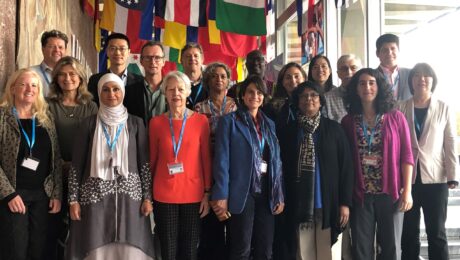
Joint FAO/WHO Expert meeting on the Safety and Quality of Water Used in Food Production and Processing
Saturday, 14 September 2019
Dr. Dima was invited to participate in the Joint FAO/WHO Expert meeting on the Safety and Quality of Water Used in Food Production and Processing in Geneva, Switzerland, 23-27 September 2019. The purpose of the meeting was to develop clear and practical guidance on the criteria and parameters that can be used to determine if water is ‘fit-for-purpose’ for several different agricultural purposes. This work is still under review. As a member of the FAO/WHO joint Expert Meeting on the Microbiological Risk Assessment (JEMRA), she contributed to developing practical guidance and fit-for-purpose microbiological criteria for water used in fresh fruit and vegetables and the published WHO document. Enjoy the read: FAO and WHO 2021. Safety and quality of water used with fresh fruits and vegetables. Microbiological Risk Assessment Series No. 37. Rome. https://doi.org/10.4060/cb7678en
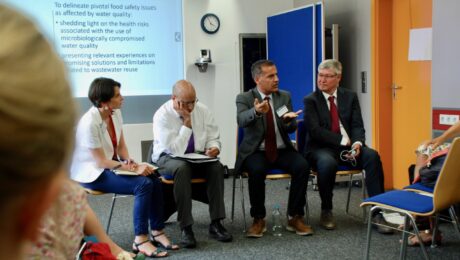
Open Space Workshop 10th Water Research Horizon Conference 2019
Friday, 14 June 2019
Food and water are two components that are strongly linked throughout the different stages of the farm-to-fork food supply chain. With the growing problem of water scarcity that is compounded by climate change, conserving water resources and seeking alternative options have become the goals of the food production and processing industries, yet the strategies and approaches vary greatly among countries. To address these challenges and devise effective wastewater treatment solutions without compromising the safety of food, Dr. Dima Faour-Klingbeil organized the Open Space Workshop “Food Safety meets Water Quality” during the 10th Water Research Horizon Conference 2019 (18th-19th June 2019) that was jointly organised by the Water Science Alliance and the Federal Institute for Geosciences and Natural Resources. The workshop brought food and water scientists and experts for an interdisciplinary discussion and to delineate pivotal food safety issues as affected by water quality and wastewater use and reuse. See the outcomes report here.
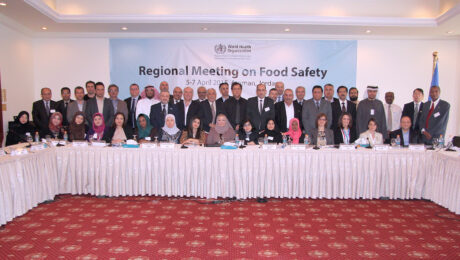
FAO Food Safety Meeting in Jordan
Tuesday, 14 April 2015
The WHO regional Centre for Environmental Health Action (CEHA), held a regional meeting for food safety officers appointed by ministries of health and ministries of agriculture in Amman, Jordan on 5–7 April 2015. Dr. Dima Faour-Klingbeil was invited as a speaker and temporary advisor. As part of the regional meeting, representatives from 19 countries along with international experts and several United Nations (UN) agencies took part in the regional celebration of the 2015 World Health Day on Food Safety on 7 April. The objectives of the meeting were to: • update participants on the state of food safety in the Region and Member States (status, gaps and challenges); • present emerging food safety issues and priorities at the global level; • identify areas to be strengthened and the way forward; and • celebrate World Health Day 2015 on Food Safety in the Eastern Mediterranean Region under the motto “From farm to plate – make food safe”. Dr. Dima’s presentation is found here.