
IAFP 2022 European Symposium – Munich
Monday, 27 June 2022
Dr Faour-Kingbeil was invited to the International Association of Food Protection Annual Meeting, Munich, German, May 4-6, 2022. She joined other experts in the symposium session titled “Safety and Quality of Water Used and Reused in Fresh Produce Supply Chains” to offer a presentation on “Bringing Fit-for-Purpose Applications into Fresh Produce Operations and Managing Control”. Water scarcity is a global issue resulting from diminishing water availability with the increasing water demand, water overuse, pollution, and changes in water availability due to climate change. Industries from all sectors have critical roles in alleviating water scarcity. Particularly the food and agriculture sectors are under the pressure of being the largest consumers of water. Further challenges are read with the rising demands for healthy fresh food and the rapid growth of the ready-to-eat and fresh-cut vegetables markets in the developed economies; Hence, while increasing food production, it is imperative to adopt strategies for efficient water use in the fresh produce industry to conserve water resources and reduce costs and environmental impact of the high volume of generated wastewater. Water reuse is one of the measures deemed appropriate to mitigate high water consumption. It is advocated as a valuable resource by the United Nations World Water Development Report and the circular economy perspective.Ultimately, water quality should fit the purpose it is used for, and recycling or reuse applications will have to consider water suitability which depends on its source. Thus, cross-contamination and recontamination risks are likely to occur without validated and verified control steps, predisposing final products to hazards. This presentation will offer an overview of water reuse in the fresh produce industry, associated risks, and currently applied solutions to prevent cross-contamination. Technological limitations and research needs are also considered. https://www.foodprotection.org/upl/downloads/meeting/program-overview/627e695c45ce4423a221b.pdf
Open Space Workshop 10th Water Research Horizon Conference 2019
Friday, 14 June 2019
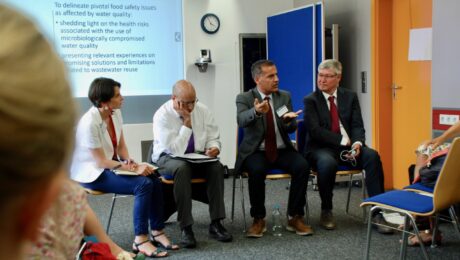
Food and water are two components that are strongly linked throughout the different stages of the farm-to-fork food supply chain. With the growing problem of water scarcity that is compounded by climate change, conserving water resources and seeking alternative options have become the goals of the food production and processing industries, yet the strategies and approaches vary greatly among countries. To address these challenges and devise effective wastewater treatment solutions without compromising the safety of food, Dr. Dima Faour-Klingbeil organized the Open Space Workshop “Food Safety meets Water Quality” during the 10th Water Research Horizon Conference 2019 (18th-19th June 2019) that was jointly organised by the Water Science Alliance and the Federal Institute for Geosciences and Natural Resources. The workshop brought food and water scientists and experts for an interdisciplinary discussion and to delineate pivotal food safety issues as affected by water quality and wastewater use and reuse. See the outcomes report here.
Training on Food Safety and Hygiene in West Bekaa – Lebanon
Saturday, 24 January 2015
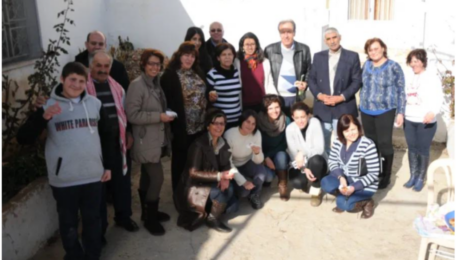
On January 24 2015, a training session on “Food Safety and Hygiene” was organized in Ein Zebde B&B in West Bekaa – Lebanon. The training was provided by Dr. Dima Faour-Klingbeil and covered the basic concepts of food safety and hygiene tailored to home cooking and moune making practices. This interactive and participatory training targeted Mouneh producers, hosts of “Tables d’Hote” and owners of small family restaurants on the West Bekaa Food Trail. Attendees expressed their satisfaction with the training and the need for continuous lectures of the sort, especially in the wake of recent food safety issues. This workshop is part of the USAID funded project entitled “Establishing A Food Trail in Higher Shouf and West Beqaa” in the framework of the Lebanon Industry Value Chain Development (LIVCD) Project. The food trail is being implemented by the Environment and Sustainable Development Unit (ESDU) at the American University of Beirut and the Food Heritage Foundation in collaboration with the Shouf Biosphere Reserve (SCBR).