
The Food Forum USA and Canada
Monday, 17 September 2018
17 September 2018: DFK was invited as a speaker to join the leading experts in the food industry and trade from the US, Canada and Germany in the Food Forum USA and Canada organized by the German Chamber of Commerce and Industry in Hannover. The forum featured presentations, experts talks, and conversations on several important trade and regulatory issues that German companies need to know, these included: industry patterns and current market trends, customer habits, import regulations or distribution channels. DFK presented an overview on the FSMA key requirements, registrations of food facilities, the role of different US agencies and the US agents, and what the industry should know and do to prepare for the FDA FSMA inspections.
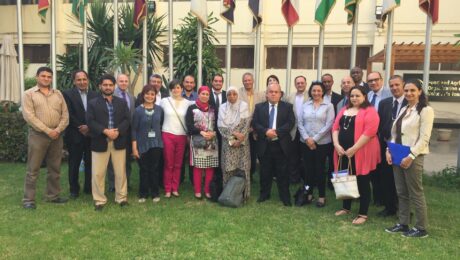
Expert group meeting on the scope and setting up of an Arab – Good Agricultural Practices (ARAB – GAP) framework
Wednesday, 01 June 2016
Cairo, Egypt, 31 May – 1 June 2016: The United Nations Economic and Social Commission for Western Asia (ESCWA), in cooperation with the Food and Agriculture Organization / Regional Office for the Near East and North Africa (FAO-RNE), organized an Expert Group Meeting on the Scope and Setting up of an Arab – Good Agricultural Practices (Arab – Gap) Framework, in Cairo during 31 May – 1 June 2016. The meeting brought together experts from government, non-government and private organizations with working experience in the areas of food quality and safety and good agricultural practices for improved food safety. The meeting was held within the framework of a project financed by the Swedish International Development Cooperation Agency (Sida), a component of which aims at promoting the adoption and use of GAPs for a responsible, effective and efficient food value chain in the Arab region. The meeting provided a platform to enhance understanding of GAPs and their relation to food safety and quality issues; review existing national, regional and international experiences; and exchange views on a proposed Arab-GAP framework. The meeting resulted in a set of conclusions on how an Arab-GAP framework could be structured, and what modalities need to be followed for its operationalization. Options were formulated on a way forward to promote the adoption of GAPs for improved food quality and safety in domestic food markets. Dr. Dima Faour-Klingbeil, ESCWA food safety consultant under the project, presented a preliminary proposal for the Arab-GAP as a third party voluntary scheme. In terms of scope, it is proposed that the Arab-GAP would cover fresh produce, being the most potentially hazardous foods that have caused recent outbreaks globally. Dr. Faour-Klingbeil noted that food safety systems have evolved over the past years and that the number of certified producers worldwide is increasing. She went on to briefly present the Arab GAP guide prepared by the Arab Organization for Agricultural Development (AOAD) in 2007, and which builds on the GLOBALG.A.P. framework. See the report here.
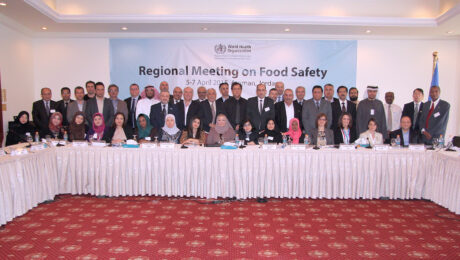
FAO Food Safety Meeting in Jordan
Tuesday, 14 April 2015
The WHO regional Centre for Environmental Health Action (CEHA), held a regional meeting for food safety officers appointed by ministries of health and ministries of agriculture in Amman, Jordan on 5–7 April 2015. Dr. Dima Faour-Klingbeil was invited as a speaker and temporary advisor. As part of the regional meeting, representatives from 19 countries along with international experts and several United Nations (UN) agencies took part in the regional celebration of the 2015 World Health Day on Food Safety on 7 April. The objectives of the meeting were to: • update participants on the state of food safety in the Region and Member States (status, gaps and challenges); • present emerging food safety issues and priorities at the global level; • identify areas to be strengthened and the way forward; and • celebrate World Health Day 2015 on Food Safety in the Eastern Mediterranean Region under the motto “From farm to plate – make food safe”. Dr. Dima’s presentation is found here.
FOOD SAFETY: “ADDED VALUE” TO THE VALUE CHAIN – EXAMPLE FROM AGRI-FOOD SECTOR, LEBANON
Monday, 01 December 2014
1-3 December 2014: Dr. Faour-Klingbeil was invited as a speaker in the Workshop on Capacity Building on Value Chain Analysis for Agribusiness for OIC Countries. She presented “Food Safety: “Added Value” to the Value Chain – Example From Agri-Food Sector Lebanon“. As produce is transported from the farm to the market place, and finally to the consumer’s fork, it is subjected to a range of handling, processing and storage conditions at each step of the food chain; hence there are numerous opportunities for contamination and the contemporary global agri-food value chain can quickly spreads the risks worldwide. Food safety violations or failures at any points of the food chain may have a devastating impact economically and on the health bills (consumers and the state). Indeed, the microbiological indicators of our case study showed that samples of raw vegetables along the chain pose risks on consumers’ health and would not fulfill the requirements for added value products. Therefore, for developing a sustainable food value chain, it is highly recommended to underpin the food safety culture within the value chain framework through risk-reduction strategies, adoption of standards and the reinforcement of commitment of all stakeholders by on-going educational interventions taking into account the social, economic and cultural factors that constrain behavioral changes.
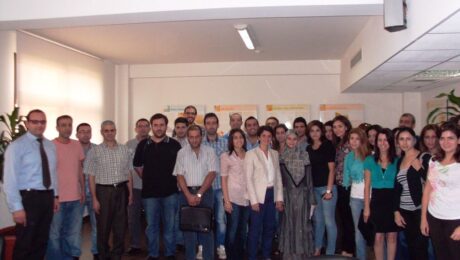
Seminar on food inspection models –
Wednesday, 14 November 2012
November 2012: within the capacity development framework for the health inspectors in the Ministry of Economy in Lebanon, Dr. Faour-Klingbeil was invited to deliver a seminar on food inspection models. Her talk covered “Approaches in Food inspection: An Insight to practices in the UK“.
- 1
- 2