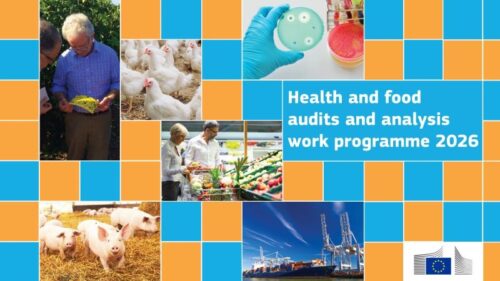
The European Commission’s 2026 Health and Food Audits and Analysis Programme sends an important signal to global agri-food exporters.
The message is clear:
EU import controls are entering a new phase of intensified scrutiny.
In response to rising concerns around food safety, regulatory alignment, and the integrity of third-country control systems, the EU is significantly scaling up audits of non-EU countries.
The focus areas for 2026 include:
🔸 Pesticide residues
🔸 Pharmacologically active substances in animal products
🔸 Contaminants and mycotoxins
🔸 Food contact materials (including recycled plastics)
🔸 Microbiological risks
🔸 Animal health and welfare standards
The Commission has committed to a 50% increase in audits of non-EU countries between 2025–2027. In 2026 alone, 51% of agri-food controls will target non-EU countries, compared to 33% in 2025.
For exporters to the EU market, this marks a structural recalibration of import scrutiny. The emphasis is no longer limited to product-level compliance, it extends to the robustness of official control systems in exporting countries.
In times of geopolitical instability and economic uncertainty, regulatory certainty becomes even more critical. The EU is reinforcing its food safety perimeter.
If your business exports to the European Union, 2026 will require:
🔸 Robust residue monitoring aligned with EU MRLs
🔸 Strong and defensible official certification systems
🔸 Full traceability across the supply chain
🔸 A documented and demonstrable compliance culture
🔸 Preparedness for on-site Commission audits
Preparedness is not optional. It is strategic for market growth and business expansion.
Below is the list of sectors falling under heightened European Commission scrutiny in 2026, together with the planned audits for non-EU countries.
EU Food Safety
Increased Audits 2026
Food categories under highest scrutiny in third-country controls, verified from the European Commission DG SANTE Health and Food Audits and Analysis Programme 2026
| # | Food Category and Scope | Audits | Relative Intensity | Priority |
|---|---|---|---|---|
| 1 |
Fish, Fishery Products and Fish Oil
China, Chile, Oman, Panama, Türkiye, Uruguay; plus 7 desk-based audits (Papua New Guinea, Senegal, Cabo Verde, Solomon Islands, Taiwan, Nigeria, Malaysia)
|
13audits | High | |
| 2 |
Residues of Pharmacologically Active Substances, Food of Animal Origin
Tunisia, Panama, Bosnia and Herzegovina, Cambodia, Republic of Korea, Bangladesh, Uruguay, Türkiye, Moldova, plus 1 TBD; desk-based assessment of 30 non-EU countries
|
10audits | High | |
| 3 |
Plants and Plant Products, Phytosanitary Controls
Uganda, Costa Rica, China, Japan (Bonsai), Peru, Thailand, plus 1 TBD
|
7audits | High | |
| 4 |
Pesticide Residues, Food of Plant Origin
Kenya, Thailand, Sri Lanka, Bangladesh, Madagascar
|
5audits | High | |
| 5 |
Food Contact Materials, Recycled Plastics
United Kingdom, India, Türkiye, China; first coordinated audit programme on this topic launched in 2026
|
4audits | New Topic | |
| 6 |
Meat and Meat Products, Beef and Poultry
Brazil (beef), Argentina (poultry and wild hare), United Kingdom (beef), Uruguay (beef)
|
4audits | Medium | |
| 7 |
Animal Health, Poultry Meat and Eggs
China, Thailand, United States
|
3audits | Medium | |
| 8 |
Live Bivalve Molluscs
Japan, Vietnam
|
2audits | Medium | |
| 9 |
Microbiological Safety, Food of Non-Animal Origin
Serbia, Türkiye
|
2audits | Medium | |
| 10 |
Contaminants, Food of Non-Animal Origin
United States; Türkiye (product-specific details per Annex 4 country audit descriptions: aflatoxin in peanuts; mycotoxins in pistachios and dried figs)
|
2audits | Medium |
Food Contact Materials with Recycled Plastics: first coordinated audit programme on this topic in EU (Netherlands, Poland) and third countries (UK, India, Türkiye, China), addressing chemical migration risks from recycled packaging.